
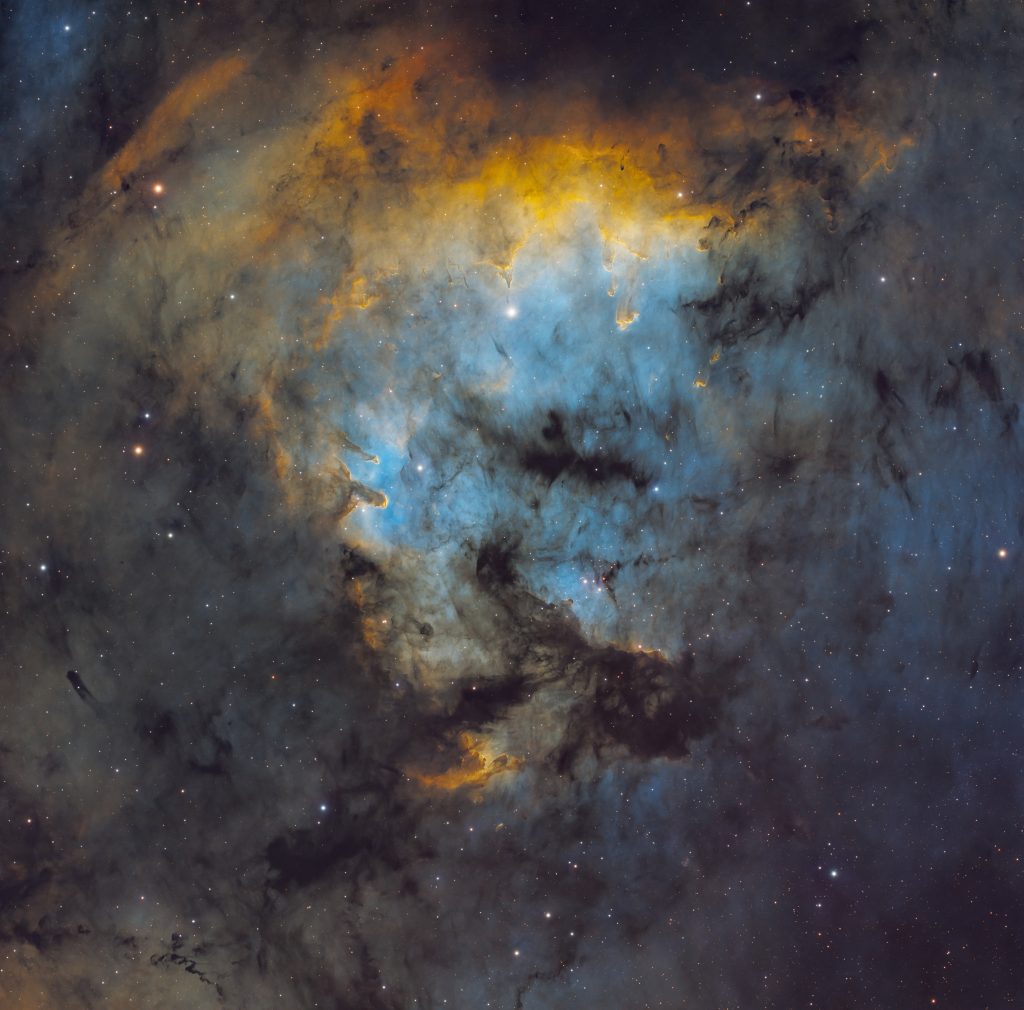
So after reading this article, hopefully, you will have a basic understanding of SHO configuration. Wrote it in point format to increase the productivity of the reader and the writer.
- Introduction to SHO Configuration
- Definition: SHO is a technique in astrophotography that utilizes Sulfur II (SII), Hydrogen-alpha (Hα), and Oxygen III (OIII) narrowband filters.
- Purpose: To capture detailed and colorful images of celestial objects, highlighting features invisible in regular broadband photography.
- Understanding the Filters
- SII Filter: Captures light emitted by sulfur ions at 672 nm, typically mapped to the red color channel.
- Hα Filter: Isolates the deep red light of hydrogen alpha emissions at 656 nm, assigned to the green color channel.
- OIII Filter: Targets the light from doubly ionized oxygen at 500 nm, mapped to the blue color channel.
- Benefits of SHO Configuration
- Enhanced Detail: Allows for the visualization of intricate structures and compositions of nebulae and other astronomical objects.
- Improved Contrast: By isolating specific emissions, it enhances the contrast between different elements in the celestial object.
- Artistic and Scientific Value: Produces visually stunning images with significant scientific information about the object’s chemical makeup.
- The Hubble Palette
- Comparison to Hubble Space Telescope imagery, which popularized the SHO configuration by producing vibrant and detailed space photographs.
- Explanation of the name: The color mapping technique is named after the Hubble Space Telescope’s iconic images.
- Processing SHO Images
- Image Acquisition: Describes capturing monochrome images through each of the three filters.
- Color Mapping: Explains assigning each filtered image to an RGB color channel (SII to red, Hα to green, OIII to blue).
- Post-Processing: Brief overview of combining these images to enhance detail and finalize the colorful representation.
- Applications and Popularity
- Usage among amateur and professional astrophotographers for its ability to reveal the unseen beauty of the cosmos.
- Contribution to both the art and science of astronomy, providing insights into the physical conditions within nebulae and other astronomical phenomena.
- Conclusion
- Emphasis on the SHO configuration as a bridge between the artistic portrayal and scientific exploration of the universe.
- Encouragement for readers to explore SHO astrophotography as a means to appreciate and understand the complexities of the cosmos.

[…] PixInsight and Photoshop to produce this final image. During the processing phase, I utilized the SHO combination to achieve the desired colors. The original size of this image is 4500×3600 pixels with a […]